Paper Plate Machines
- Double Die Paper Plate Machine
- Fully Automatic Paper Plate Machine
- Hydraulic Paper Plate Machine
- Paper Plate Making Machines
- Single Die Paper Plate Making Machine
Notebook Making Machine
- Notebook Cutting Machine
- Notebook Edge Squaring Machine
- Notebook Making Machine
- Notebook Spiral Binding Machine
- Notebook Stitching And Folding Machine
- Notebook Stitching Machine
Incense Making Machines
- Automatic agarbatti making machine
- Camphor Tablet Making Machine
- Dhoopbatti Making Machine
- Manual agarbatti making machine
Food Processing Machine
- BREAD SLICER MACHINE
- 4 BOLT OIL EXPELLER MACHINE
- 6 bolt oil expeller machine
- 9 BOLT OIL EXPELLER MACHINE
- Atta Chakki Machine
- Automatic paneer press machine
- Automatic rice mill with polisher
- Besan Making Machine
- Cattle feed machine
- Centrifugal chalna seperator
- Chapati Making Machine
- COLD PRESS OIL EXPELLER MACHINE
- Cotton Candy Making Machine
- Dal dryer machine
- Dal polisher machine
- Fully automatic noodles making machine
- Khoya Making Machine
- Kurkure Making Machine
- Kurkure roaster machine
- Laddu making machine
- Malli machine
- Masala coating machine
- Masala Making Machine
- Mini oil expeller machine
- Mini Rice Mill Machine
- Momos Making Machine
- Mustard Oil Expeller Machine
- Namkeen making machine
- Noodles Making Machine
- Oil And Hydro Dryer Machine
- OIL FILTER MACHINE
- Paneer press machine
- Pani Puri Making Machine
- Papad making machine
- Pasta Making Machine
- Planetary mixer machine
- Popcorn making machine
- Potato peeler machine
- Potato slicer machine
- RASGULLA MAKING MACHINE
- Soda vending machine
- Sugarcane juice machine
- Tomato Sauce Making Machine
Other Machines
- Concrete Vibrating Machine
- Automatic slipper machine
- Concrete Mixing Machine
- Cotton Wick Machine
- Hydraulic Press Brick Making Machine
- Ladies Bindi Making Machine
- Manual slipper machine
- Mini chaff cutter machine
- Paper cup making machine
- Sambrani cup making machine
- Sanitary Pad Making Machine
- Tissue Paper Making Machine
- Wire nail grinder machine
- Wire Nail Making Machine
- Wire nail polishing machine
Packing Machines
Detergent Making Machines
Rotary Oven Machine
- 12 tray rotary oven
- 18 tray rotary oven
- 24 tray rotary oven
- 36 tray rotary oven
- 42 tray rotary oven
- 84 tray rotary oven
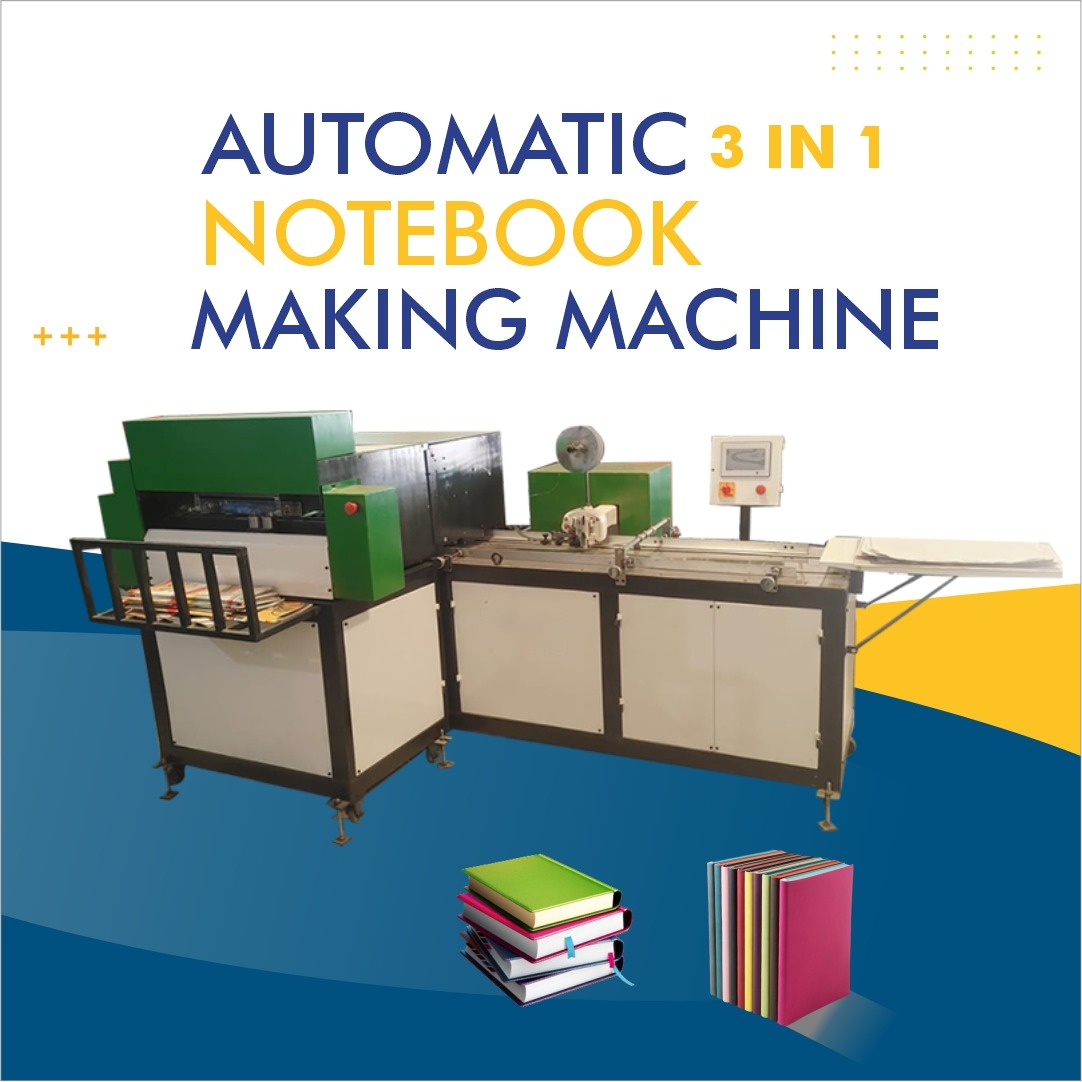
Notebook Making Machine in Damoh Madhya Pradesh – High-Speed Notebook Production Line
Price: ₹.90000.00
Introduction
If you are establishing or expanding a notebook manufacturing facility in or around Damoh, Madhya Pradesh, investing in the right notebook making machine is crucial. A professional notebook making machine ensures high output, minimal downtime, and consistent quality, enabling you to meet customer demands efficiently. In this detailed content, we explore what to look for in a notebook production line, why choosing a supplier in Damoh makes sense, how the machine works, typical specifications, cost considerations, operational tips, maintenance practices, and the benefits of using a modern notebook manufacturing machine. We will also weave in synonyms for “notebook making machine” (such as “notebook production line”, “exercise-book manufacturing machine”, “booklet production machine”, “notebook assembly machine”, “notebook manufacturing equipment”) to help SEO and clarity.
1. Why Use a Notebook Making Machine (Notebook Production Line)
A notebook production line (or notebook making machine) automates many of the manual tasks involved in traditional book-manufacturing. Rather than cutting paper, folding, binding, stitching and edge squaring by hand, the machine handles them in sequence, ensuring speed, accuracy and consistency. For example, one fully automatic machine lists features like multi-head wire stitching, folding unit, edge squaring and PLC controls. Endurance Machinery+1
Some key benefits of using modern notebook manufacturing equipment:
-
Higher throughput: Machines offer capacities ranging from thousands of pieces per hour. smallmediumbusinessindia.com+1
-
Better quality and consistency: Uniform stitch placement, fold accuracy, edge squaring and finishing improve product appearance and durability. kesyainternational.com+1
-
Reduced labour cost and error: Automation reduces manual work and errors in cutting, folding, binding.
-
Flexibility: Many machines allow size changes, thickness variations, and different binding styles—ideal for a notebook manufacturing line that serves multiple products. namibind.com+1
-
Scale-ability: As demand grows (for schools, retailers, wholesalers), the investment in a notebook making machine pays off through higher capacity and lower per-unit labour cost.
Given these advantages, if you are in Damoh (or broader Madhya Pradesh), positioning your manufacturing unit with a reliable notebook making machine enables you to compete on volume, quality and cost.
2. Why Location: Damoh, Madhya Pradesh
Choosing to site your notebook manufacturing operation in Damoh, Madhya Pradesh offers several strategic benefits:
-
Central location: Damoh sits in the heart of Madhya Pradesh. Being centrally located helps you access markets in northern, central and eastern India with relatively lower transportation costs.
-
Lower overheads: Compared to metro regions, land, utilities and labour costs in Damoh are likely lower—helping you keep manufacturing cost-effective.
-
Availability of skilled/unskilled labour: Being a district area of Madhya Pradesh, you can draw from local workforce and potentially train them for notebook machine operation, quality control and maintenance.
-
Logistics access: With highway links and (potentially) freight logistics, you can receive raw materials (paper, board, binding wires) and dispatch finished notebooks efficiently across India.
-
Growth opportunity: As educational demand, stationery consumption and distribution in India expand, a manufacturing setup in Damoh gives you the chance to serve regional markets effectively.
By combining a strong notebook making machine with a strategic site such as Damoh, you can build a competitive notebook manufacturing business.
3. Key Features & Specifications of a Notebook Making Machine
When selecting a notebook assembly machine (or notebook manufacturing equipment) you must evaluate a range of technical features to ensure you get the right fit for your production needs. Below are key specifications and why they matter:
3.1 Production Capacity
-
Determine how many pieces per hour or per shift the machine can produce. For instance, some machines list capacities of 3,000 pieces per day in manual setup. sbsmachine.com
-
For automatic machines, capacity may reach several thousands per hour (e.g., 3,500 pieces/hour or more) depending on size and automation level. smallmediumbusinessindia.com+1
-
Align capacity with your expected demand: if you aim for large volumes (schools, wholesale notebooks) you may need a higher-capacity line.
3.2 Automation Level
-
Machines come in manual, semi-automatic and fully automatic versions. Manual machines require more operator intervention (cutting, folding, binding). sbsmachine.com
-
Fully automatic lines incorporate cutting, stitching/folding, edge squaring and finishing in one continuous flow. sikandarmachines.com+1
-
Automatic lines deliver higher speed and consistency; manual may be suitable for smaller production or startup.
3.3 Machine Material & Build Quality
-
The frame should be robust—mild steel, stainless steel etc. For example, machine material listed as mild steel or stainless. smallmediumbusinessindia.com+1
-
Precision parts, branded components (motors, PLC, wires) improve durability and reduce downtime.
3.4 Size & Format Flexibility
-
Notebook size and thickness: Many machines support a range of sizes and thicknesses. Example: one automatic machine handles notebook length from 10″ to 30″, width 10″ to 18″, thickness 8 mm. sikandarmachines.com
-
Wire specification (for binding), number of stitch heads, fold mechanism, edge squaring unit all matter for flexibility.
3.5 Control & Technology
-
Modern machines incorporate PLC (programmable logic controller) based control and servo motors for accuracy and ease of operation. Endurance Machinery
-
Settings storage for different notebook sizes, automatic adjustments, quick changeover are valuable for manufacturing flexibility. namibind.com+1
3.6 Support & Maintenance
-
Availability of spare parts, after-sales service, training for operators and maintenance personnel are critical to smooth operations and uptime.
-
When sourcing the machine in India (or sourcing from outside and installing locally) make sure you have local support, ideally within Madhya Pradesh or neighbouring states.
3.7 Cost of Ownership
-
Initial capital cost of machine is a one-time expense, but remember operating cost includes electricity/power, consumables (wire, binding materials), labour for operators, maintenance, and waste/scrap.
-
Evaluate pay-back period: higher capacity machine may cost more but can deliver lower cost per notebook and faster ROI.
4. How the Notebook Manufacturing Process Works with the Machine
Below is a step-by-step of how a modern notebook making machine (notebook production line) works, from raw material to finished notebook. Understanding this helps you optimise layout, workflow and staffing.
Step 1: Feeding Raw Material
-
Sheets of paper (for the inner pages) and cover boards or printed covers are stacked and fed into the machine.
-
In some machines, automatic feeders handle the input of printed sheets and covers in sequence.
Step 2: Cutting & Trimming
-
The machine may cut the sheet size, trim the edges to required dimensions, and prepare the pages for folding or binding. Example: in some machines, cutting is built-in. smallmediumbusinessindia.com+1
-
Precise cutting ensures uniform size and clean edges, which contributes to product quality.
Step 3: Folding (if required)
-
Depending on notebook format (e.g., fold matters for signatures), the machine may include a folding unit to fold sheets into the correct form. Example: automatic notebook making machine includes folding function. Endurance Machinery+1
Step 4: Stitching / Binding
-
The machine binds the folded or stacked pages with wire stitching (centre stitch), or other binding type (depending on machine and notebook type). Example: multi-head wire booking stitching. sikandarmachines.com
-
Accurate stitching ensures durability and proper opening of notebooks.
Step 5: Edge Squaring and Finishing
-
After stitching, the stack passes through edge-squaring unit which ensures clean edges and uniform appearance. Example: edge squaring feature. sikandarmachines.com+1
-
Additional finishing may include trimming, cover lamination, corner rounding, embossing variably.
Step 6: Output and Stacking
-
Finished notebooks come off the production line and are stacked/palletised for packaging.
-
Quality inspection ensures that binding, trimming and finish meet standards.
Layout Considerations
-
The machine requires sufficient space for input (paper stacks), machine bed, operator access, finished output.
-
Utilities: Power supply (voltage and phase – many machines require 3-phase supply), compressed air (if pneumatic feeds), ventilation for dust etc.
-
Workflow: Position raw material storage, machine, finished goods area logically to minimise handling.
5. Choosing the Right Machine for Your Requirements in Damoh
When operating from a location like Damoh, MP, you should customise your machine choice based on specific factors:
5.1 Volume of Production
-
Estimate your target monthly production (e.g., 100,000 notebooks per month, or more) and make sure capacity aligns.
-
If demand is moderate or you are just starting, a semi-automatic or lower-capacity machine may suffice and help limit capital investment.
5.2 Notebook Formats & Variants
-
Determine the typical sizes you plan to manufacture (A4, A5, custom school notebooks, exercise books) and choose a machine that supports those sizes.
-
If you plan to offer multiple sizes, go for flexibility in size changeover and adjustable settings.
5.3 Budget and Return on Investment
-
Balance between cost of machine and expected revenue from output. A higher-end machine may cost more but deliver faster throughput and lower unit cost.
-
Factor in local costs in Damoh: labour, power, rental/land costs. A more efficient machine may reduce labour cost and thereby improve profitability.
5.4 Local Support & Maintenance
-
Since you are in Madhya Pradesh (not a metropolitan area), ensure the machine supplier has service support within reasonable reach (state or neighbouring states).
-
Check for parts availability, training for operators and preventive maintenance schedules.
5.5 Machine Footprint and Utilities
-
Check that your facility in Damoh has adequate floor space, proper power supply (voltage, phase), and required infrastructure (foundation level, load bearing, ventilation).
-
Plan for raw material storage, finishing and packing area adjacent to machine for efficient workflow.
6. Cost Considerations and Financial Implications
Investing in notebook manufacturing equipment requires careful financial planning.
Capital Expenditure
-
Machine cost varies widely depending on capacity, automation level, brand and features. For example, a manual full setup starts from a lower cost (e.g., in Delhi listing ~Rs 1.7 lakh for a manual full setup). sbsmachine.com
-
Fully automatic machines cost substantially more (multiple lakhs of rupees) depending on capacity and features. smallmediumbusinessindia.com+1
Operational Costs
-
Power consumption (motors, servo drives, lighting for area).
-
Labour costs: Operators, helpers, quality inspectors, maintenance staff.
-
Raw material costs: paper, covers, wires, binding accessories.
-
Maintenance, spare parts, downtime.
-
Waste/scrap from mis-runs or machine set-up errors.
Revenue and ROI
-
Determine selling price per notebook, volume you expect, and cost per unit with the machine.
-
A higher-capacity machine reduces cost per unit, speeding up pay-back.
-
For example, if you produce 5,000 notebooks/day vs 1,000/day, your fixed cost is spread over more units, improving margins.
Running in Damoh
-
Factor local costs: lower real-estate, logistics to markets, but possibly higher logistics cost to raw material centres if they are distant.
-
Ensure you have a solid distribution channel to maximise output utilisation.
7. Operational Tips for Notebook Manufacturing Equipment
To get the best from your notebook production line (notebook making machine) operation in Damoh, consider these operational best practices:
-
Training of Operators: Ensure operators understand machine functions (feeds, trimming, stitching, edge squaring), set-up for different sizes, troubleshooting.
-
Preventive Maintenance: Regular cleaning, lubrication, inspection of moving parts, checking alignment and stitch quality.
-
Quality Control Protocols: Check over 100% of first pieces after change-over, monitor binding integrity, page alignment, trimming accuracy.
-
Efficient Material Flow: Arrange raw material storage near machine to reduce handling time; ensure finished goods area is organised for packing and dispatch.
-
Changeover Efficiency: If producing different formats, reduce downtime by pre-configuring size settings, storing machine programmes, training staff for fast changeover.
-
Dust & Waste Management: Paper cutting generates dust; dust extraction and housekeeping improve machine life and working conditions.
-
Spare Parts Stock: Maintain critical spares (stitch heads, blades, wires) locally to avoid delays.
-
Energy Monitoring: Monitor power usage, aim for energy-efficient operation (e.g., turn off idle machines, optimize shift timing).
8. Maintenance and Longevity of Notebook Production Equipment
Durability of your notebook making machine is key to long-term profitability.
-
Routine Inspection: Daily checks of belts, wires, stitching heads, folds, edge squaring tables.
-
Calibration: Ensure precision of cutting, stitching and folding remains within tolerance to avoid defective products.
-
Spare-part replacement schedule: Wear parts (blades, stitch heads, feed rollers) need replacement after certain hours.
-
Service agreements: If available, purchase a service agreement with your supplier or local technician for annual overhaul.
-
Upgrades: Some machines allow modular upgrades (e.g., more stitch heads, servo drives) so you can scale as business grows.
-
Documentation: Maintain machine logs (hours run, production units, maintenance done) to plan downtime during lean periods, not peak demand.
9. Benefits of Investing in a Notebook Making Machine in Damoh
By choosing a modern notebook manufacturing equipment setup in Damoh, you gain strategic advantages:
-
Competitive manufacturing cost: Lower overheads in Damoh + high throughput machine = lower cost per notebook.
-
Faster delivery/time to market: With local manufacturing you reduce transportation time for regional markets in Madhya Pradesh, Uttar Pradesh, Chhattisgarh.
-
Quality differentiation: Better binding, trimming and finish than purely manual processes gives you a market edge.
-
Scalability: As stationery demand rises (schools, colleges, retail), your machine can handle larger volumes.
-
Sustainability: Modern machines often use energy-efficient drives, reduce waste—important for regulatory compliance and brand image.
-
Job creation and local economy benefit: Setting up in Damoh helps local economy and may open up local incentives (if any) for industrial units in Madhya Pradesh.
10. Final Thoughts & Next Steps
If you are considering establishing or upgrading a notebook manufacturing unit in Damoh, Madhya Pradesh, here is a recommended roadmap:
-
Define your product mix and volumes: What sizes, page counts, binding types do you plan? 2. Estimate demand and capacity: How many notebooks/month do you aim for? 3. Shortlist machine suppliers: Evaluate capacities, automation level, service network, cost. 4. Visit demo or installed sites: If possible inspect machines in operation. 5. Plan facility layout in Damoh: Power supply, space, utilities, material flow. 6. Calculate total cost and ROI: Include machine cost, installation, training, raw materials, labor, utilities. 7. Arrange for installation and training: Ensure manufacturer or local partner will install, test and train staff. 8. Start production and continuous improvement: Monitor quality, reduce waste, optimise production flow.