Paper Plate Machines
- Double Die Paper Plate Machine
- Fully Automatic Paper Plate Machine
- Hydraulic Paper Plate Machine
- Paper Plate Making Machines
- Single Die Paper Plate Making Machine
Notebook Making Machine
- Notebook Cutting Machine
- Notebook Edge Squaring Machine
- Notebook Making Machine
- Notebook Spiral Binding Machine
- Notebook Stitching And Folding Machine
- Notebook Stitching Machine
Incense Making Machines
- Automatic agarbatti making machine
- Camphor Tablet Making Machine
- Dhoopbatti Making Machine
- Manual agarbatti making machine
Food Processing Machine
- BREAD SLICER MACHINE
- 4 BOLT OIL EXPELLER MACHINE
- 6 bolt oil expeller machine
- 9 BOLT OIL EXPELLER MACHINE
- Atta Chakki Machine
- Automatic paneer press machine
- Automatic rice mill with polisher
- Besan Making Machine
- Cattle feed machine
- Centrifugal chalna seperator
- Chapati Making Machine
- COLD PRESS OIL EXPELLER MACHINE
- Cotton Candy Making Machine
- Dal dryer machine
- Dal polisher machine
- Fully automatic noodles making machine
- Khoya Making Machine
- Kurkure Making Machine
- Kurkure roaster machine
- Laddu making machine
- Malli machine
- Masala coating machine
- Masala Making Machine
- Mini oil expeller machine
- Mini Rice Mill Machine
- Momos Making Machine
- Mustard Oil Expeller Machine
- Namkeen making machine
- Noodles Making Machine
- Oil And Hydro Dryer Machine
- OIL FILTER MACHINE
- Paneer press machine
- Pani Puri Making Machine
- Papad making machine
- Pasta Making Machine
- Planetary mixer machine
- Popcorn making machine
- Potato peeler machine
- Potato slicer machine
- RASGULLA MAKING MACHINE
- Soda vending machine
- Sugarcane juice machine
- Tomato Sauce Making Machine
Other Machines
- Concrete Vibrating Machine
- Automatic slipper machine
- Concrete Mixing Machine
- Cotton Wick Machine
- Hydraulic Press Brick Making Machine
- Ladies Bindi Making Machine
- Manual slipper machine
- Mini chaff cutter machine
- Paper cup making machine
- Sambrani cup making machine
- Sanitary Pad Making Machine
- Tissue Paper Making Machine
- Wire nail grinder machine
- Wire Nail Making Machine
- Wire nail polishing machine
Packing Machines
Detergent Making Machines
Rotary Oven Machine
- 12 tray rotary oven
- 18 tray rotary oven
- 24 tray rotary oven
- 36 tray rotary oven
- 42 tray rotary oven
- 84 tray rotary oven
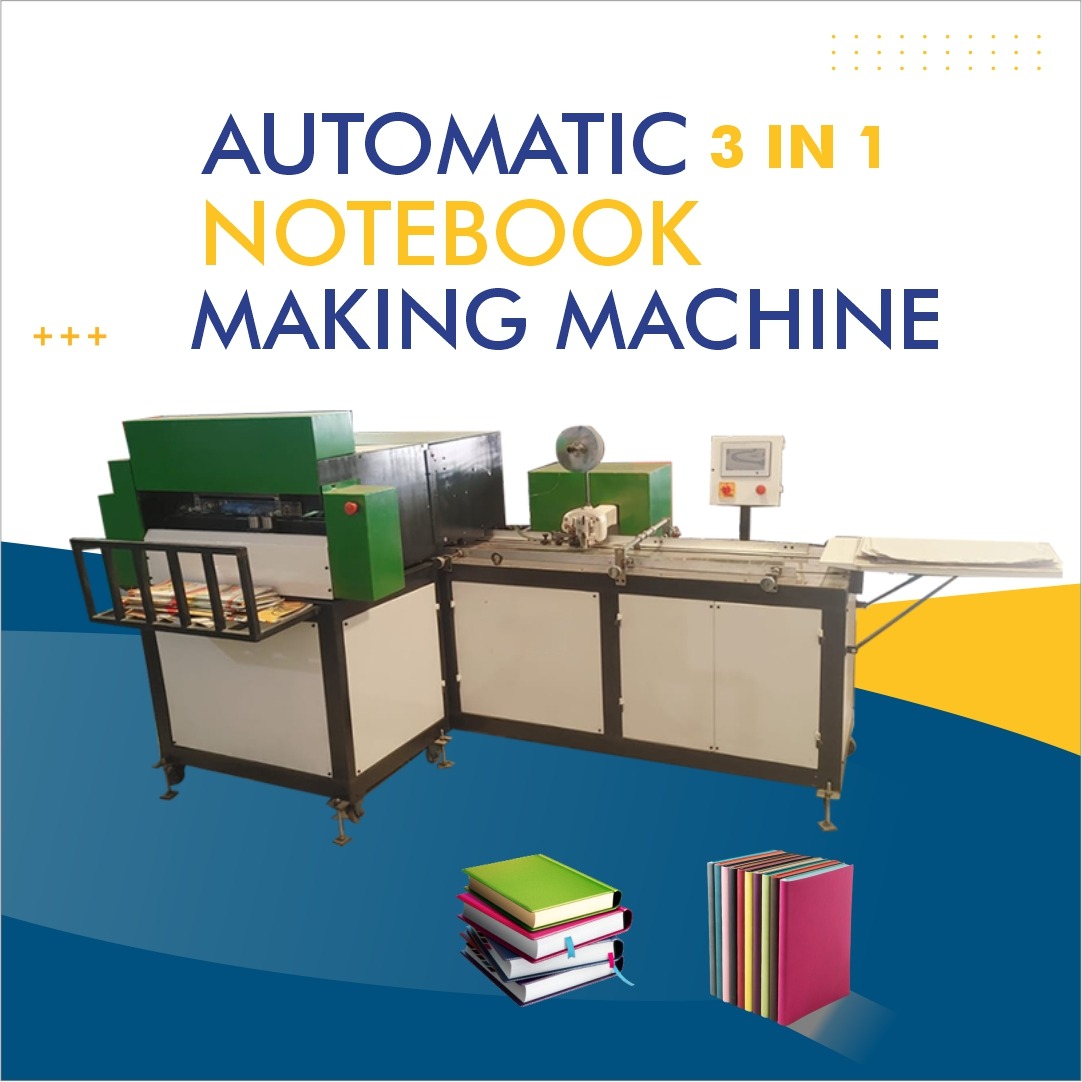
Notebook Making Machine Manufacturer in Bagepalli Karnataka | High-Efficiency Notebook Production Equipment
Price: ₹.90000.00
Notebook Making Machine Manufacturer in Bagepalli | Karnataka
If you are looking to invest in a reliable notebook making machine, and you are based in or around Bagepalli in Karnataka, you have come to the right place. In an era when the stationery industry is under pressure to increase productivity, reduce waste and improve quality, selecting the right notebook production machinery becomes crucial. This article explains everything you need to know about the notebook making machine — its features, benefits, types, how to choose, installation & support, cost considerations, and why Bagepalli Karnataka is a suitable location for deployment.
What is a Notebook Making Machine
A notebook making machine is a piece of industrial equipment designed to automate or semi-automate the production of notebooks — the type used for writing, journalling, school use, office use, and so on. The machine handles tasks such as paper cutting, folding, stitching, gluing, binding, trimming and packaging. As one manufacturer outlines, the machine can include functions such as multi-head wire stitching, folding, edge-squaring and PLC-controlled operations. Endurance Machinery+1 The notebook making machine ensures consistent output, high speed, better binding strength, and reduced labour costs.
Synonyms you might encounter include notebook production machinery, notebook manufacturing equipment, notebook assembly line machine, and notebook production equipment. These terms are often used interchangeably when referring to the broader set of machinery involved in notebook manufacturing.
Why Choose a Notebook Making Machine for Your Business
There are several compelling advantages to investing in a dedicated notebook making machine:
-
Increased Productivity: Manual processes limit the number of notebooks you can produce per hour. A modern machine can deliver thousands of pieces per day. For example, a manual setup noted a production capacity of 3,000 per day. sbsmachine.com+1
-
Consistency of Quality: Machines ensure consistent dimensions, binding strength, and finishing, which is critical for brand reputation and customer satisfaction.
-
Cost Efficiency: Over time, reducing manual labour, minimising rework and waste, and increasing throughput lowers the per-unit production cost.
-
Flexibility in Formats: Good machines support different notebook sizes, thicknesses, binding styles (wire, staple, glue), enabling more product variation.
-
Scalability: As your business grows, you can move from a manual or semi-automatic machine to a fully-automatic setup, increasing capacity without entirely re-engineering your process. For instance, one fully automatic model listed capacity of up to 9,000–10,000 pieces/day. sbsmachine.com+1
Types of Notebook Making Machines
When you look for notebook making machines, you’ll typically find the following categories:
-
Manual Notebook Making Machine
In this configuration, much of the process is performed manually, with the machine assisting in specific steps like cutting or folding. These are suited for small-scale operations or startups. Example: a “manual notebook making machine full setup (SBS NB-01)” showcased in India. sbsmachine.com -
Semi-Automatic Notebook Making Machine
These machines automate certain tasks (such as paper cutting, stitching or gluing) but still require manual intervention for feeding, unloading or finishing steps. Semi-automatic machines strike a balance between cost and productivity. shkimachinery.com+1 -
Fully-Automatic Notebook Making Machine
These machines perform most operations automatically, often including folding, stitching, edge-squaring, trimming and packaging in one continuous line. These are ideal for established factories with high output demands. Example: a machine with speed of 800 books per hour and full PLC control. Endurance Machinery
Key Features & Technical Specifications to Consider
When selecting a notebook making machine, evaluate the following features:
-
Production capacity: How many notebooks per hour or per day the machine can produce. For example, some manual machines capacity ~3,000/day. sbsmachine.com+1
-
Automation grade: Manual, Semi-Automatic or Fully Automatic.
-
Supported notebook size/thickness: Length, width and thickness ranges of notebooks the machine can handle. Example: one machine supports notebook length 10"-30", width 10"-18". Endurance Machinery
-
Binding method compatibility: Wire-stitching, glue-binding, staple binding etc.
-
Material & build quality: Machine body in MS or steel, durable components, reliable safety features.
-
Control system: PLC controls, servo drives, automation for precision. Example: use of servo for pin-to-pin accuracy in folding & stitching. Endurance Machinery
-
Power & utilities requirement: Voltage, phase (single/three), power consumption, footprint of machine.
-
After-sales service & spare parts availability: Critical for uptime and longevity of equipment.
-
Upgradability: Ability to add new features or expand capacity in the future.
-
Footprint & layout: The machine size, required space, and integration into your manufacturing layout.
Why Bagepalli, Karnataka is an Ideal Location
Locating your notebook manufacturing setup in Bagepalli (Karnataka) offers several advantages:
-
Accessibility: Bagepalli is well-positioned to serve markets in southern and south-western India, enabling distribution across Karnataka, Andhra, Tamil Nadu, Telangana and beyond.
-
Cost-effective labour: Lower overheads compared to major metropolitan manufacturing hubs.
-
Industrial ecosystem: Proximity to industrial clusters and suppliers may reduce logistic costs for raw materials like paper, board, binding wires.
-
Infrastructure: With suitable power and transport connectivity, a well-planned facility in Bagepalli can run efficiently.
-
Local competitive advantage: Locating outside of very high-cost metros may allow you to offer more competitive pricing while maintaining quality.
How to Choose the Right Supplier & Machine
To ensure you pick the right notebook making machine and supplier, follow these steps:
-
Define your production target
Decide how many notebooks per day or per month you intend to produce. This will determine the required capacity of the machine (manual vs semi-auto vs full auto). -
Specify the range of notebook formats
What sizes, thicknesses, binding styles you will manufacture. Choose machine that supports your formats and has margin for future diversification. -
Check supplier credentials
-
Ask for previous installations, customer references, machine performance data.
-
Verify service network and availability of spare parts.
-
Ensure factory acceptance test or demo run is offered.
-
-
Compare technical specifications & cost
Do not select purely based on lowest cost; consider the total cost of ownership including maintenance, downtime, spare parts replacement, training. -
Assess support & training
Ensure operator training, maintenance training and prompt service visits are part of the package. -
Site preparation & infrastructure
Before arrival of machine, ensure your plant in Bagepalli has adequate floor area, power supply, foundation (if required), ventilation, loading/unloading access, and raw material staging. -
Future proof your investment
Even if you are starting at lower capacity, select a machine that can be upgraded or expanded so your machine investment remains relevant.
Investment & Cost Considerations
While actual machine costs vary widely depending on capacity and automation, some benchmark figures (from Indian manufacturers) provide a guide:
-
Manual notebook making machine setup: Example cost ~ ₹1.70 Lakh for a 3,000 /day manual machine. sbsmachine.com
-
Semi-automatic machine: Larger investment but higher capacity; pricing available in industry listings. shkimachinery.com
-
Fully automatic notebook making machine: High capacity and sophistication; one machine listed at Rs.15.75 Lakh (~US$19,000) with speed ~800 books/hour. Endurance Machinery
Additional costs to consider: installation and commissioning, operator training, tooling and changeover materials, building civil work, raw material stocking, maintenance spares, power & utilities. Also ensure you budget for initial raw materials (paper, binding wires, covers) and any inventory before full-scale production.
The Notebook Production Process Explained
To give full context, here is a typical notebook production workflow when using a notebook making machine:
-
Paper cutting: Sheets are cut to size from large rolls or sheets. Precision cutting ensures uniformity.
-
Folding: Sheets may be folded if required (for inner pages). The machine may handle folding.
-
Stitching/Binding: The core production step – the pages are bound together. This could be wire-stitching, staple stitching or glue binding. The machine may do multi-head wire stitching (in automatic machines). Example: one machine uses multi-head wire booking stitching. Endurance Machinery
-
Trimming & Edge Squaring: After binding, edges are trimmed and squared off so the notebook looks neat and professional. Edge squaring is often built into mid-to-high end machines. Endurance Machinery
-
Cover attachment: Covers are attached to the bound pages (hard or soft covers).
-
Finishing/Packaging: The finished notebooks may go through pressing, quality checks and then be packaged for distribution.
-
Inspection & Quality Control: Checking for binding strength, page alignment, cover registration, trimming accuracy.
Having the right machine ensures each of these steps is executed efficiently and with minimal manual intervention — which means fewer defects and higher output.
Benefits for Your Business in Bagepalli
By installing a well-chosen notebook making machine in your facility at Bagepalli, you can unlock several business benefits:
-
Faster turnaround: Shorter lead times from raw material to finished notebook means you can respond quicker to orders.
-
Competitive pricing: Greater efficiency and scale help you reduce cost per notebook and pass on value to your customers.
-
Better quality & consistency: Uniform production helps build your brand reputation among wholesalers, schools, retailers.
-
Opportunity for product diversification: With a flexible machine you can introduce different notebook formats, premium binding types or customized covers, capturing niche markets.
-
Local advantage: Being based in Bagepalli allows you to target south-India markets with lower logistic cost and quicker distribution compared to farther-away manufacturing centres.
-
Scalability: Start with semi-automatic, grow to full-automatic as demand increases — your machine investment grows with your business.
Installation, Maintenance & After-Sales Support
Your investment in the notebook production machinery must be supported by strong installation and maintenance protocols:
-
Ensure the supplier provides detailed installation drawings, foundation requirements (if any), utility (power, air compressor) hookups and operator training.
-
Regular preventive maintenance should be scheduled — include cleaning, lubrication, inspection of stitching heads, trimming blades, sensors.
-
Keep spare parts inventory for consumables and frequent wear parts (blades, stitching wires, belts) to reduce downtime.
-
Ensure there is a support network — either local or remote — for troubleshooting, replacement parts, and upgrades.
-
Logging machine run-hours, downtime, maintenance history helps ensure optimal performance and return on investment.
Risk Mitigation & Checklist
Before you proceed, consider the following checklist to reduce risk:
-
Confirm machine dimensions, floor layout, power supply compatibility (voltage, phase) and supplier lead-time.
-
Request a demo or video of the machine in operation (preferably producing the notebook format you intend to manufacture).
-
Clarify warranty terms, what parts are covered, what consumables cost, and how fast spare parts can be shipped to your location.
-
Verify the supplier’s reputation: ask for references of other customers using their machines in notebook manufacturing.
-
Scope out raw material procurement: ensure your paper, covers, binding wires are available locally or are timely imported.
-
Consider logistic cost of transporting the machine to Bagepalli, installation cost, training cost, and any civil work required.
-
Plan your cash-flow: machine purchase, installation, raw materials, staffing and initial orders before revenue flows in.
-
Ensure you have the right workforce: operators, machine maintenance, quality inspectors and logistic support.
Conclusion
If you are establishing or expanding a notebook manufacturing business in Bagepalli, Karnataka, investing in the right notebook making machine is a strategic step. With the right capacity, automation grade and supplier support you can position your business for increased productivity, consistent quality and competitive pricing. Whether you choose a manual, semi-automatic or fully-automatic notebook production machine will depend on your current demand, budget and growth plans. By aligning your machine choice with your business model, you set the foundation for scalable operations and long-term success.